

Automation is reshaping the grinding industry, and centerless grinders are among the machines benefiting most from this transformation. As demand increases for higher throughput, consistent precision, and reduced labor dependency, manufacturers are turning to automated feeding systems and robotic loading solutions to modernize their grinding processes.
Automation is no longer only for high-volume mass production. Today, even mid-size operations are integrating robotics into grinding lines to improve efficiency and eliminate human-dependent variables.

Feeding workpieces manually into a centerless grinder requires operator experience, continuous concentration, and physical effort. Inconsistent loading positioning, speed variations, or fatigue can directly affect grinding quality, causing dimensional drift or surface inconsistency.
As labor shortages become common globally, manual grinding operations struggle with:
Variable productivity
Inconsistent tolerances
Higher scrap rates
Increased training requirements
These challenges make automation a logical and increasingly necessary next step.
Automated feeders—such as vibratory bowl feeders, conveyor systems, and magazine-style loaders—are designed to process parts continuously and repeatably.
By controlling feed rate, spacing, and alignment, automated feeding ensures stable grinding conditions, improving both cycle time and quality. This is particularly valuable for industries requiring high-volume repeatability, such as:
Medical device components
Automotive pins and shafts
Bearings and rollers
Fasteners and precision hardware
Consistent feeding means the grinder can maintain ideal pressure, wheel wear distribution, and dimensional tolerance.
Modern robotic arms provide unmatched positioning accuracy and programmable movement paths. Unlike traditional mechanical automation, robots can handle parts of differing sizes, shapes, and materials without major mechanical changes—only software-level adjustments.
Robotic loading provides several advantages:
Faster and repeatable pickup/placement
Reduced manual intervention
Automatic orientation and alignment
Integration with vision systems for quality sorting
When paired with centerless grinding, this enables true continuous production with minimal downtime.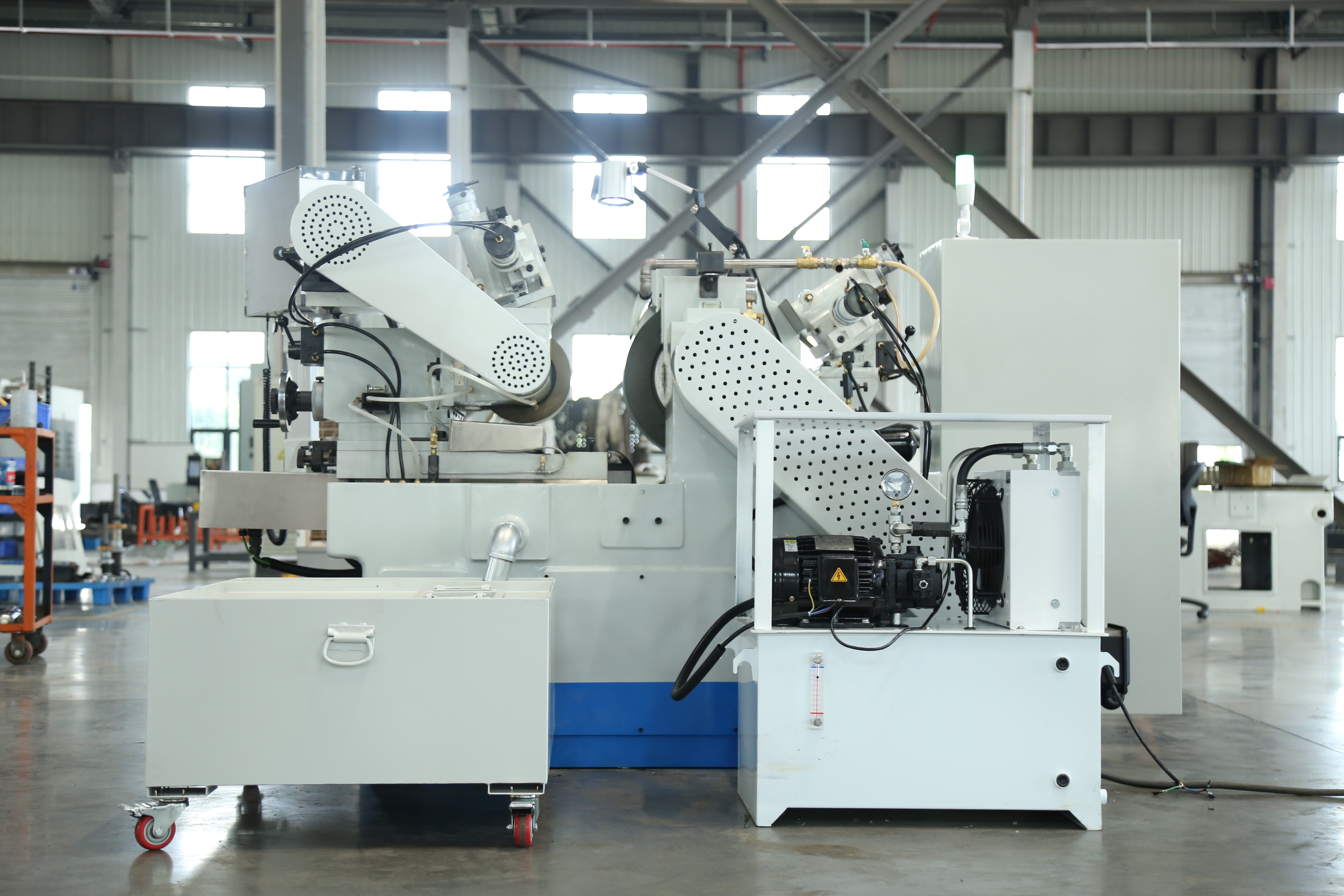
Automation becomes even more powerful when combined with CNC controls. CNC centerless grinders can synchronize feed rates, grinding parameters, and compensation adjustments with robotic movement, creating a seamless workflow.
Features like auto-compensation, adaptive grinding, and in-process gauging ensure precision remains consistent—even during long production runs.
Machines such as the YASHIDA CG-18S-1A CNC Centerless Grinder are designed with automation compatibility in mind. The system supports:
Robotic gantry or articulated arm loading
Auto wheel dressing and sizing compensation
Servo-controlled feeding for micro-adjustment
Touchscreen programming for easy automation integration
Using imported high-precision Japanese and Taiwanese components, the model offers extended durability and long-term stability—making it ideal for automated production environments.
While automation requires an initial investment, the long-term benefits are significant:
✔ Reduced labor dependency
✔ Stable 24/7 production
✔ Lower per-part manufacturing cost
✔ More predictable scheduling
✔ Improved operator safety
Automation transforms grinding from an operator-driven process into a controlled manufacturing system designed for output, repeatability, and quality.
Automated feeding and robotic loading are no longer future trends—they are the present reality of advanced grinding technology. Centerless grinders equipped with automation are enabling manufacturers to achieve higher productivity, consistent precision, and scalable production models.
For companies pursuing Industry 4.0 or lights-out manufacturing, automation is the critical bridge from traditional machining to fully intelligent grinding systems.

This website uses cookies to ensure you get the best experience on our website.
 Español
 Portugues
 Pусский
 العربية



 Phone
Phone
Comment
(0)