
 Español
 Portugues
 Pусский
 العربية
Centerless Cylindrical Grinding
Centerless cylindrical grinding is a precision machining process used to produce accurate and smooth cylindrical surfaces without the need for centers or chucks to hold the workpiece. Instead of being clamped at its ends, the workpiece is supported and rotated between two wheels and a work rest blade. This configuration allows high‑speed production, excellent repeatability, and the ability to grind very slender or delicate parts that would be difficult to support conventionally.The process uses three key elements: the grinding wheel, the regulating (or control) wheel, and the work rest blade. The grinding wheel, made of abrasive grains bonded together, performs the actual material removal. The regulating wheel, usually made of a rubber‑bonded or resin‑bonded abrasive, controls the rotational speed of the workpiece and its feed rate through the grinding zone. The work rest blade supports the workpiece between the two wheels at a precise height, typically slightly above the centerline connecting the wheel centers, to ensure proper roundness and stability.There are two main types of centerless cylindrical grinding: through‑feed and in‑feed (also called plunge) grinding. In through‑feed grinding, the workpiece is fed axially between the wheels and exits on the opposite side. This method is suited for simple cylindrical parts with a constant diameter, such as pins, tubes, and shafts. In in‑feed grinding, the workpiece does not pass through; instead, the wheels are fed into a specific portion of the part. This allows grinding of shoulders, steps, tapers, and other more complex geometries, as long as they can be supported on the work rest.Centerless grinding offers several advantages over traditional cylindrical grinding. Because the workpiece is not clamped, setup times can be shorter, and a wide range of part lengths can be processed efficiently. The process is ideal for mass production, delivering high throughput with consistent dimensional accuracy and surface finish. It can maintain tight tolerances on diameter, roundness, and cylindricity, often in the micrometer range. In addition, multiple parts can sometimes be ground simultaneously, further increasing productivity.However, the process requires precise setup and alignment. The height and angle of the work rest blade, the tilt and speed of the regulating wheel, and the condition of the grinding wheel all have a strong influence on the quality of the result. Proper coolant application is also important to control temperature, reduce wheel loading, and extend tool life. When correctly configured and maintained, centerless cylindrical grinding is a highly effective method for producing high‑quality cylindrical components for industries such as automotive, aerospace, bearing manufacturing, medical devices, and general engineering.
Products
Category:
-
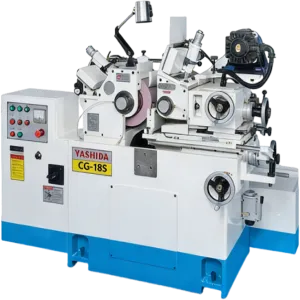
CG-18S High-Precision Centerless External Cylindrical Grinding Machine
Category: Manual Centerless External Grinding MachineBrowse number: 427Number:Release time: 2026-03-13 21:21:04The Machine Is Made Of Milhanna Cast Iron With Shock Absorption And High Stability .
Dynamic/Static Pressure Spindle (Optional) The Grinding Wheel And Adjusting Wheel Spindle Are Made of Nickel-chromium Alloy Steel.
The Adjusting Wheel Is Driven By A Servomotor For Higher Rotation Accuracy And Is Digitally Controlled For Segment-free Transmission.
This product is a manual centerless grinder.The Series Of Models Is Easy To Operate ,No Special Adjustment ,High Cost Performance.
News
Category:
No search results found!
Case
Category:
No search results found!
Video
Category:
No search results found!
Download
Category:
No search results found!
Job
Category:
No search results found!
Featured Products
No search results found!



 Phone
Phone